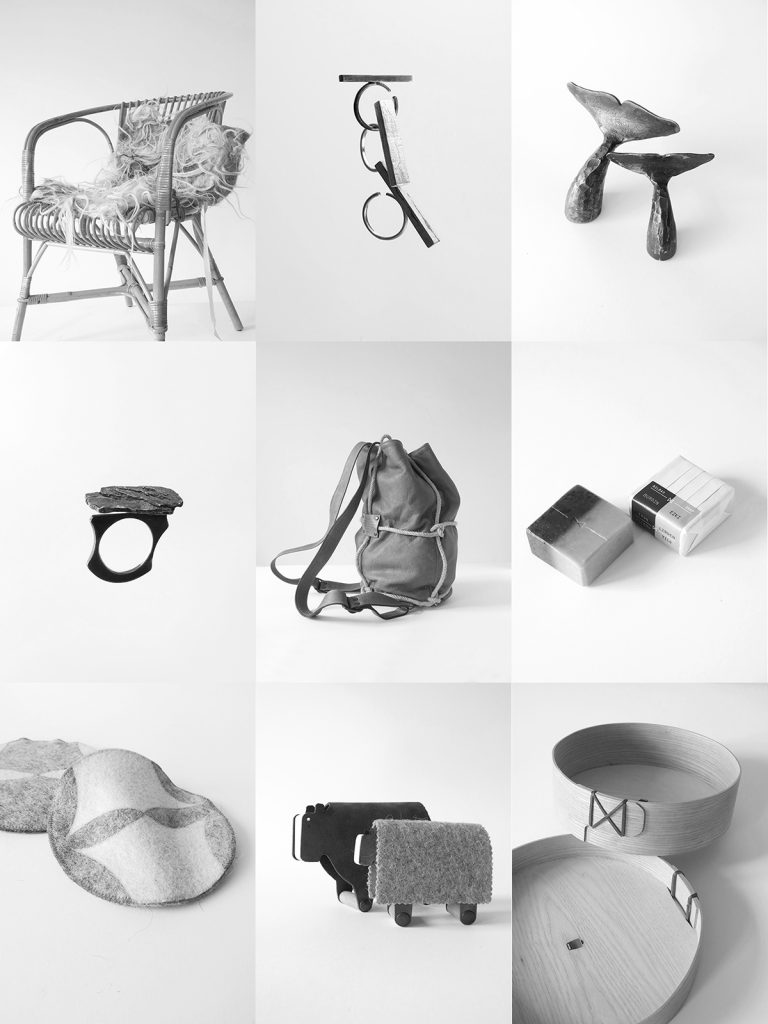
Eskutik
Craft products are closely related to a lifestyle associated with a territory’s natural resources and traditions that go back in time. It is in this context that the Eskutik project fits in. Martin Azua directed the working sessions in which collaborative projects were developed between artisans and designers that highlighted local resources and traditions. The authorship of the projects was shared between the participating designers and artisans.
The products developed received a mention in the National Design Awards, 2021.
Eskutik Workshops, Beaz Bizkaia, Bilbao, 2019.
Craftsmanship and design a shared project / Martín Azúa
After extensive experience in projects and programmes aimed at improving artisan products through collaboration with designers, I have been able to confirm that in many cases this collaboration acts as if it were a novelty. There is a barrier of mistrust between designers and artisans built on prejudice and ignorance of a history of design full of examples of collaboration between the two disciplines. If we want to look for the origin of this false controversy, perhaps we have to go back to the origins of design. Design arose from the separation between idea and execution. Execution began to be industrial and artisanal production ceased to be relevant for mass-market products. It was considered that industrial manufacture was imposed on handicraft production for reasons of quality and price. There is a tendency to think that the industry has reduced craftsmanship to a very secondary role, but it has not eliminated it. In fact, the first designers already saw craftsmanship as an opportunity to reflect on ethical and aesthetic questions. Since then craft has had this unacknowledged role of being an instrument for innovation and reflection within the field of design. If we were to start listing the countless designers who have worked with craft resources throughout the history of the discipline, the list would be as long as it is relevant.
Design has made use of industrial resources for mass-market products, but has continued to use craft resources in the field of creation. On the other hand, craftsmanship has continued to be present in the production of some sectors in which technological evolution had not generated a break with tradition. I am referring to sectors such as fashion, furniture, decoration, jewellery, gift items, souvenirs, where craftsmanship has been recognised as a differentiating factor compared to purely industrial production.
Craft resources are often closely linked to a lifestyle associated with a territory’s natural resources and traditions that go back in time. Design can enhance this craft heritage by communicating the cultural values of these products. In some cases, these artisan resources continue to operate on a productive scale that can be interesting for supplying very specific market segments. It is in this context that the Eskutik project fits in. In the workshops we will discover traditional objects that can inspire contemporary products. The objects that are developed will be a way of sharing with tourists and visitors certain values and peculiarities of Basque culture in general and that of Bizkaia in particular.
The workshop has been promoted under the philosophy: Craftsmanship and design, a shared project. Developing a methodology that implies a new way of collaboration. The participants, craftsmen and designers, understand that the two disciplines can collaborate with respect and consideration. The results will be the fruit of mutual understanding and benefit. To this end, an agreement was proposed with the aim of establishing the terms of collaboration of each team composed of an artisan and a designer. This agreement contemplates aspects such as shared authorship, production, and commercialisation rights. Aspects that usually generate friction and misunderstandings if they are not addressed clearly from the outset.
In the development of the workshop, a collaboration strategy has been established with the following premises: “Get to know each other before collaborating”. Investing time in getting to know each other; visiting the workshops and studios, learning, talking about each other’s professional challenges and expectations, is an important investment for the project. “Collaboration is sharing. The skills of artisans and designers are different, but complementary and equally important in developing a good project. Collaboration has taken place from the beginning, it has been a shared project, but with specific responsibilities; the craftsman brings material and technological culture, the designer brings the culture of the project. The final formalization of the object has been the result of this dialogue and collaboration.
Craftsmanship and design have a shared past and a future full of exciting challenges if we do not forget that behind the professional roles there are diverse, complex, and interesting people.
